- Nnewi Must Reclaim Manufacturing Hub, Pat Utomi
By Uche Nnabuchi
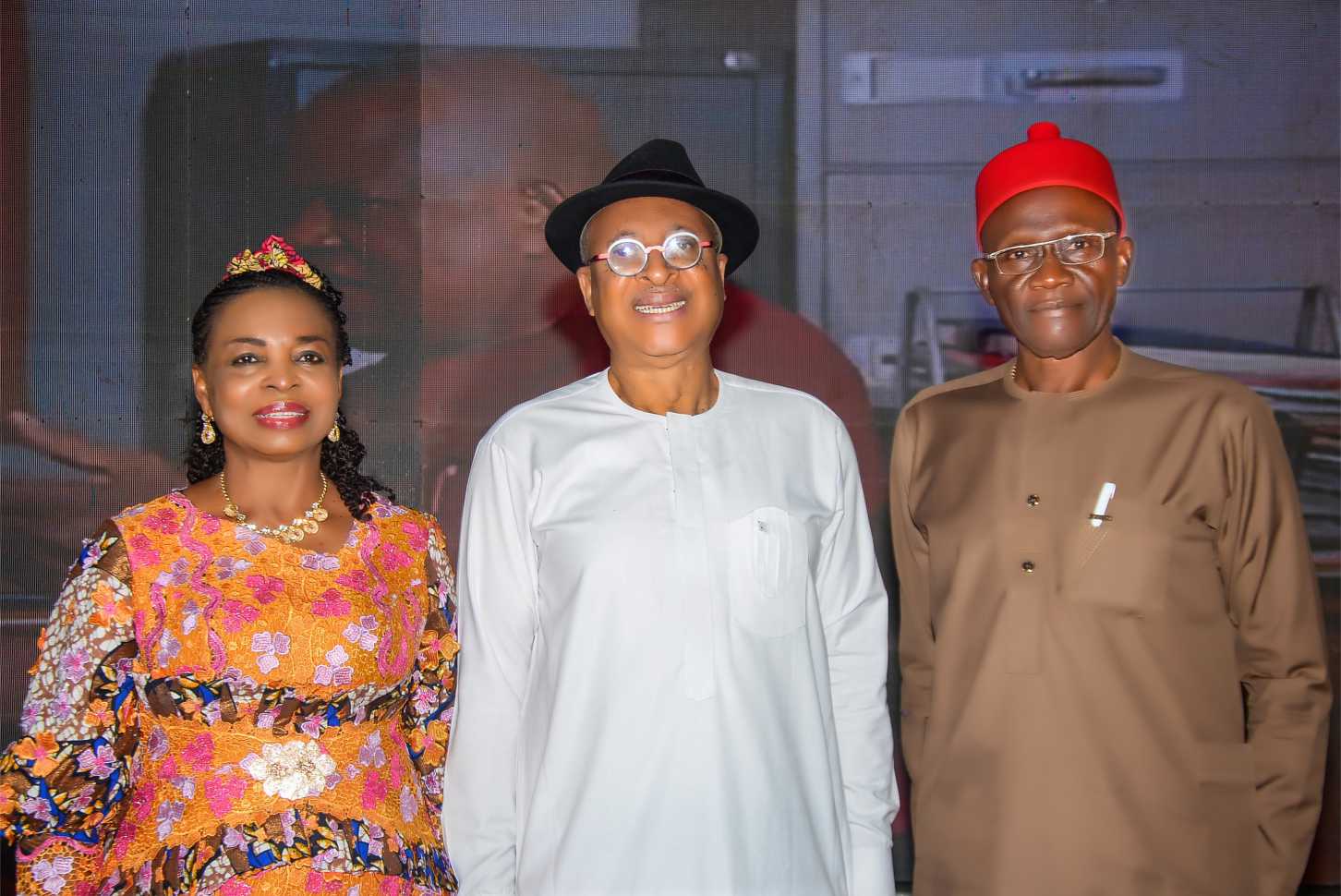
It was a historic moment in the commercial city of Nnewi, Anambra State, as the Nnewi Chamber of Commerce, Industry, Mines and Agriculture (NCCIMA) inaugurated its 12th President and first female President, Pastor (Mrs) Patricia Uchenna Chukwu, Ph.D.
The investiture, which was held at Classic Munich Hotels and Resort, Nnewi, also marked the handover ceremony by the outgoing President, Chief Sir Moses Ezukwo, who expressed deep gratitude to members and stakeholders for their support throughout his tenure.
Speaking during the handover, Chief Ezukwo said the collective progress recorded by the Chamber was made possible by the trust, commitment and invaluable contributions of its members.
“Your trust, commitment and invaluable contributions have been instrumental to our collective progress, and I remain deeply grateful for your support. Thank you for your advice, your constructive criticisms and your cooperation throughout my tenure,” he said.
Ezukwo appreciated traditional rulers, community leaders, government agencies, business leaders and all those who supported his administration, noting that while leadership is temporary, institutions are permanent.
“As I hand over today, I do so with confidence that the Chamber has a strong future ahead. My greatest wish is that the incoming administration will build on the foundation we have laid, introduce new ideas, strengthen existing programmes and take the Chamber to even greater heights,” he stated.
He said though he was leaving office, he was not leaving the Chamber, pledging to remain a member, stakeholder and advocate for the growth of the Nnewi business community.
“I leave office, but I do not leave the Chamber. I remain a member, a stakeholder and an advocate for the growth and development of the Nnewi business community. Whatever contribution I can make in the future, I will gladly do so,” he said. Sir Ezukwo described his 2-year reign as remarkable and period of service, learning, challanges, collaboration, and most importantly, meaningful progress. Appreciating his executives, Board, various committess and others for their immense support and cooperation, Ezukwo urged them to extend same to his successor to ensure a greater Chamber.
In her acceptance speech, the new President, Pastor Patricia Chukwu, who made history as the first female to lead the Chamber, promised to promote a culture of innovation and competitiveness in an increasingly digital and knowledge-driven economy.
She said businesses of NCCIMA members must be equipped to take advantage of technology, emerging market research and development, as well as new opportunities for local and international trade.
Chukwu disclosed that her administration would sustain and drive the recently flagged-off Igbo apprenticeship programme, _Igba Boi_, to dimensions that would bring massive economic returns to communities.
She also vowed to ensure that before the end of her tenure, the permanent site of the Chamber, which presently exists only as an architectural design on paper, would be built and completed.
According to her, achieving the goals is not what the President alone can do, stressing that the success of her administration will depend on the commitment of members whom she called upon to actively participate in the programmes and activities of the Chamber.
She said she accepted the responsibility with humility and determination and promised to lead the Chamber with integrity, transparency, accountability, openness and respect for the diverse interests of all members.
In his keynote address, the Founder, Centre for Value in Leadership and Professor at Lagos Business School, Prof. Pat Utomi, attributed the underdevelopment of the South-East to inconsistent policies, weak and corrupt institutions.
Speaking on the theme, “Repositioning Nnewi as Africa’s Premiere Hub for Commerce, Manufacturing and Enterprise Development,” Utomi identified steady policy somersaults as a major factor militating against industrial growth in the zone.
He also cited lack of continuity and business sustainability among old entrepreneurs following their reluctance to introduce their children to their businesses.
The Professor of Political Economy advocated industrial policies that would support private initiatives as well as active engagement between policy makers and businessmen.
Citing South Korea as an example, he said, “The country, which was once poorer than Nigeria, is currently much richer than many European countries. Even in Africa, we have several instances. We need passionate commitment from policy makers and entrepreneurs willing to change the world, which is possible.”
The renowned Political Economist, Utomi, challenged Nnewi and Anambra State to develop strategic industrial policies capable of restoring the city’s position as a major manufacturing hub.
He said Nnewi’s renowned entrepreneurial spirit had not translated into its full industrial potential, attributing this to poor policies, inadequate policy responses and missed economic opportunities.
Recalling past initiatives involving international institutions, including the World Bank and International Finance Corporation, Utomi said opportunities to accelerate industrial development in Nnewi and Aba had been lost.
He also cited an African Export-Import Bank (Afreximbank) initiative to establish manufacturing clusters across Africa, saying Anambra was considered but the opportunity eventually moved to Ogun State.
Utomi urged stakeholders to rethink Nnewi’s industrial strategy by identifying the region’s factor endowments, skills and comparative advantages, rather than simply pursuing industries that appear profitable elsewhere.
“If you want to become a leading hub, we don’t jump into anything that somebody looks like is making money from. We must ask ourselves: what are our factor endowments?”
He challenged the business community to take greater initiative in driving industrial development, while pointing to the transformation of Addis Ababa, Ethiopia, as evidence of what deliberate planning, infrastructure and industrial organisation can achieve.
Utomi concluded with a direct challenge to Nnewi: “These are the things Nnewi should be ten times as much, but people are moving elsewhere. How are we going to turn that around? This is a challenge that is before us.”
Chairman of the occasion, Ide John Udeagbala, Mayor of Aba City who ably represented Engr Dr Jani Ibrahim, National President of Nigerian Association of Chambers of Commerce, Industry, Mines and Agriculture ( NACCIMA) formally inaugurated the 18-member NCCIMA Executive Committee.
Highlights of the colourful programme included presentation of awards to deserving members and the unveiling of the NCCIMA architectural building.
The ceremony attracted government officials, captains of industry, traditional rulers, religious leaders, bussiness executives and community stakeholders.